How to Rank in ChatGPT
To rank in ChatGPT, let OpenAI's search crawler and Bing reach your site, answer buyer questions in the first line of every section, and earn mentions on websites AI already trusts. There's no paid slot and no fixed #1. It cites the few sources it can find, understand and verify, and this guide shows you how to become one of them.

Nikhil Batra · SEO consultant since 2022 · Updated
Prefer to watch? Start here.
Watch it first, then use the guide below as your checklist.
In September 2026, I asked ChatGPT to recommend trusted wedding photographers in Raipur. It listed seven studios, and my client sat at #3, ahead of a studio with 457 reviews. My client had 27.
That wasn't luck. I've done SEO since 2022, and since 2025 I've tested why AI names one business and skips the next.
This guide is what that testing taught me. Prefer to hand it over? That's what my AI SEO services are for.
What ranking in ChatGPT actually means
Ranking in ChatGPT means being one of the businesses or pages it names, links or cites when someone asks about your field.
There are no ten blue links, just one written reply and a handful of sources. You're in it or you're not.
You'll hear three labels for this work:
- SEO: search engine optimization, ranking pages on Google and Bing.
- AEO: answer engine optimization, making content easy for AI to quote.
- GEO: generative engine optimization, getting AI to mention and cite you.
GEO and AEO, built on SEO
Some people treat ChatGPT SEO as a brand-new discipline. I don't.
Every AI reply I've studied traces back to the same foundations: crawlable pages, clear information and a reputation other websites confirm.
No paid slots and no fixed position one
You can't buy your way into the reply. OpenAI says top placement can't be guaranteed, and that the ads now shown in some chats don't influence its answers.
Replies also shift with the person, their location and their wording. So by ChatGPT rankings I mean how often you're named across many real prompts, not one lucky screenshot.
How ChatGPT picks the sources it cites
ChatGPT builds each reply from two places: what it learned in training, and what it finds in a live web search when the question needs fresh information.
For local or recent questions, the live side usually decides, and it's the side you can influence fastest.
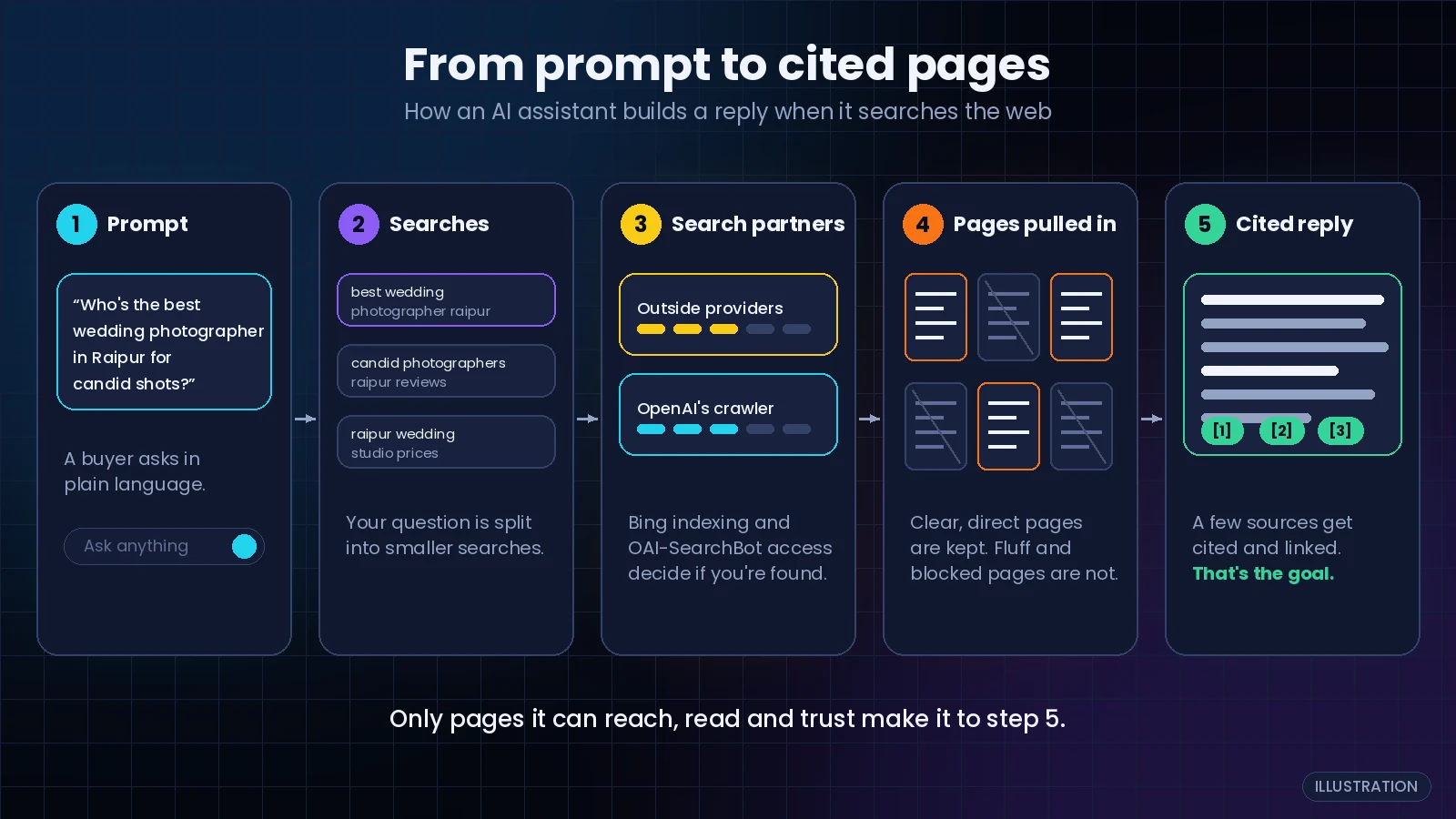
OpenAI's help pages explain that it rewrites your question into targeted searches, sends them to its search partners, then cites the pages it leaned on.
If your page isn't in those results, it can't be cited. If it's buried in fluff, it gets skipped.
Training data versus live search
The training side is slow and broad. It reflects what the web has said about you for years.
The live side is fast and specific. I work on both, but I fix the live side first, because changes there can show up within weeks.
Why a Google rank doesn't carry over to AI answers
Owners often tell me, "I'm on page one, so I'm fine in AI." Often they're not, because the two systems weigh information differently:
| What matters | Classic search results | ChatGPT replies |
|---|---|---|
| What you see | Ten links, plus ads, maps and snippets | One written reply with a few cited sources |
| The goal | Get your page onto page one | Get named, quoted or linked inside the reply |
| Biggest signals | Relevance, links and page experience | Clarity, outside mentions, freshness, crawler access |
| Where pages come from | Googlebot's own index | OpenAI's crawler plus outside search providers |
| How you track it | Search Console and rank trackers | A fixed prompt set, tested weekly |
The overlap is real, but partial. Strong Google rankings help you get discovered, but the page that gets quoted is the one that answers the question most clearly.
Proof from my own client work
Here's a real result. Raipur Wedding Photography is a studio in Raipur, India, that only started building its online presence in 2026.
I handled its Business Profile, on-page SEO and AI SEO.
#3 of 7
in ChatGPT's top picks
27 vs 457
my client's reviews vs the studio below it
5 assistants
naming the studio
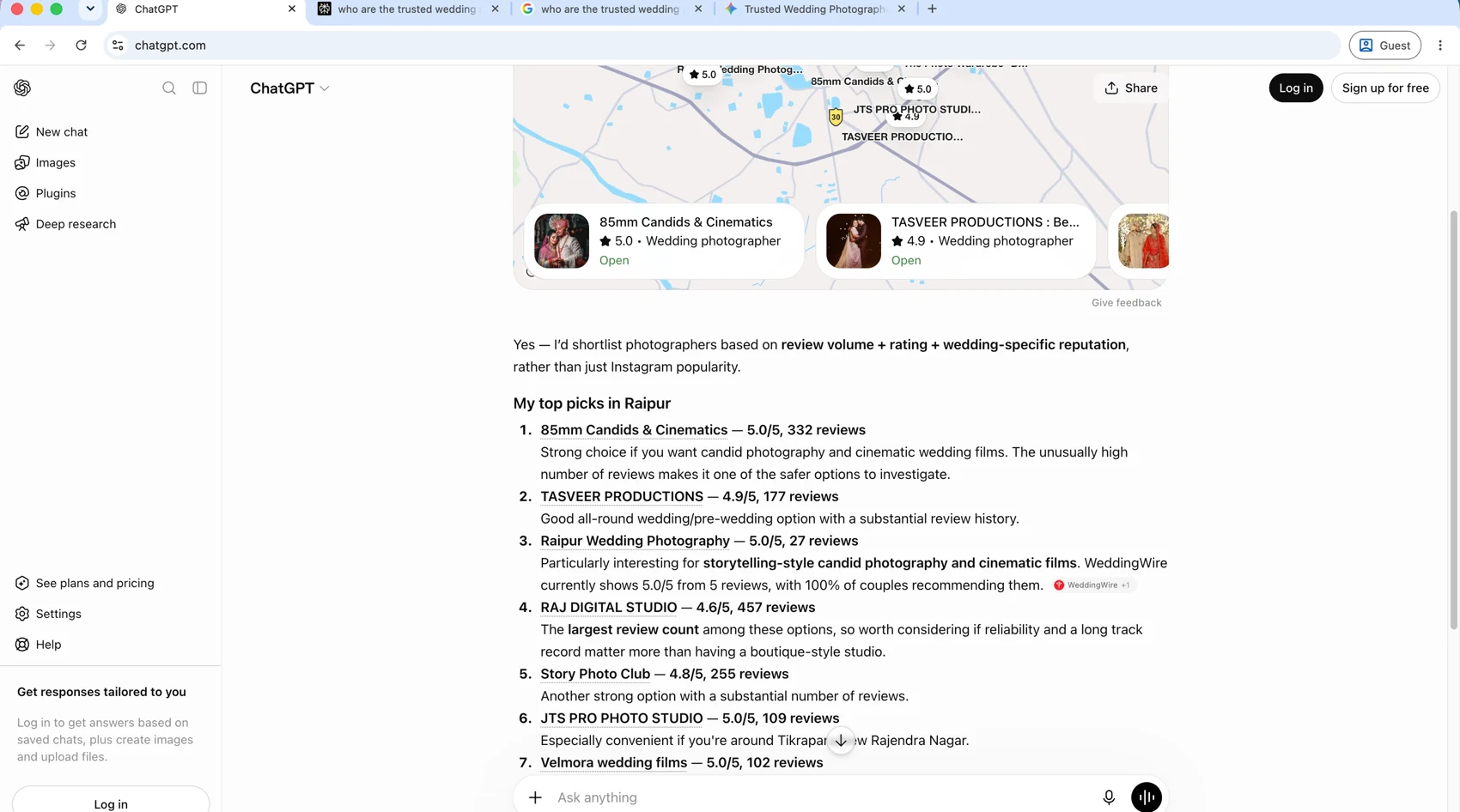
- It listed my client #3 out of 7, with a 5.0 rating from 27 reviews.
- It described the studio's strength as storytelling-style candid photography and cinematic films.
- It cited WeddingWire, a third-party listing, as a source.
Why 27 reviews beat 457
The studio at #4 had 457 reviews. Review count clearly wasn't everything.
My client's details were clear, consistent across the web and confirmed by an outside listing. In my experience, that combination gets a business named.
The same business in four other AI tools
It wasn't a one-off. The same groundwork got the studio named by the other major AI tools:
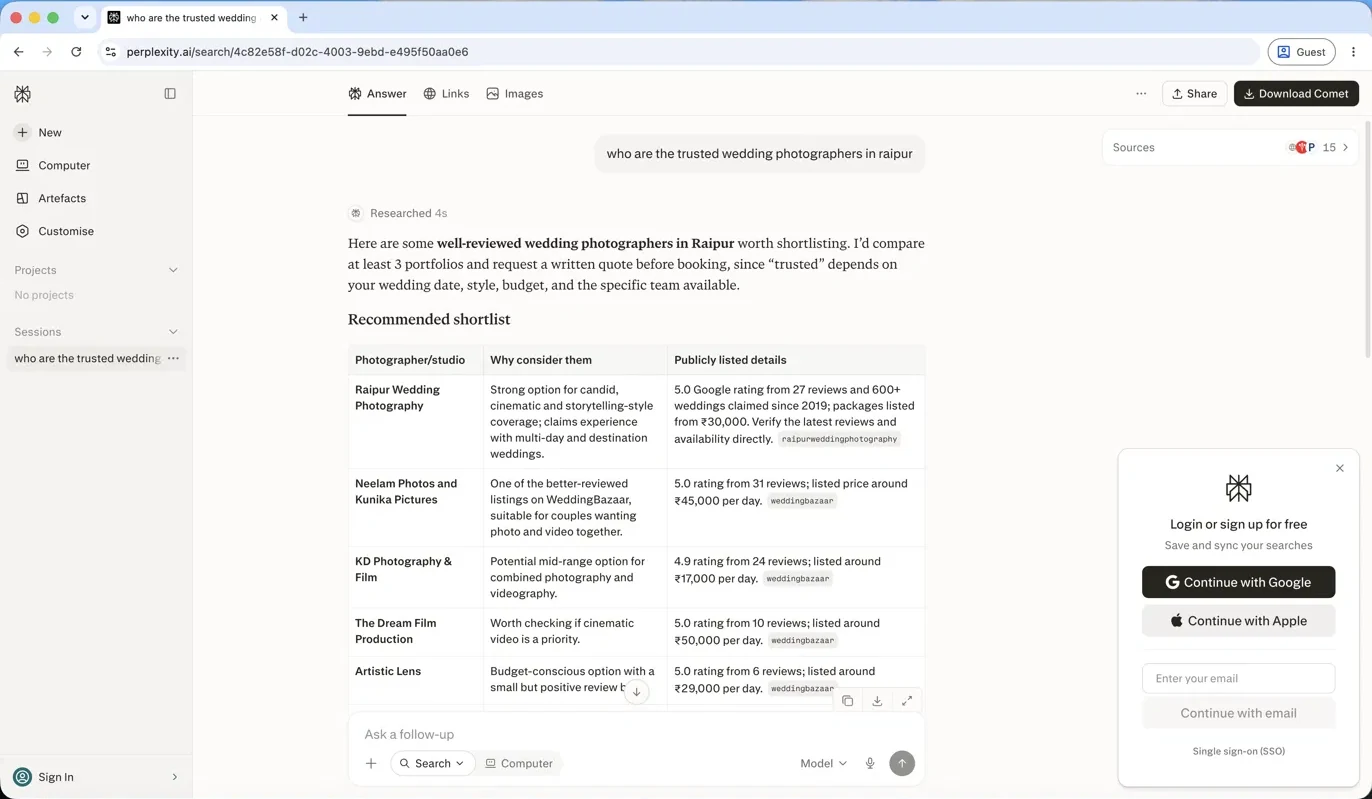
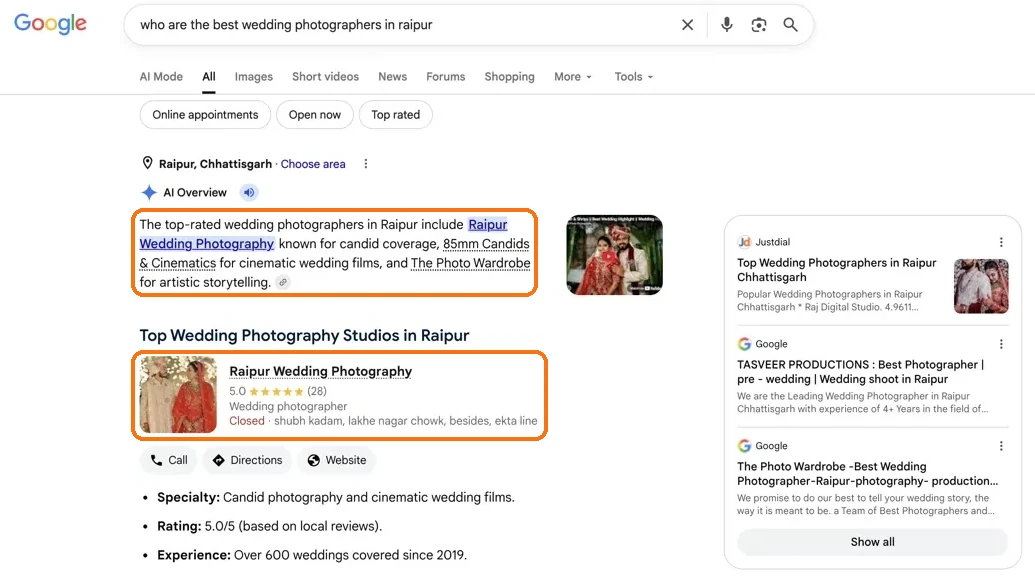
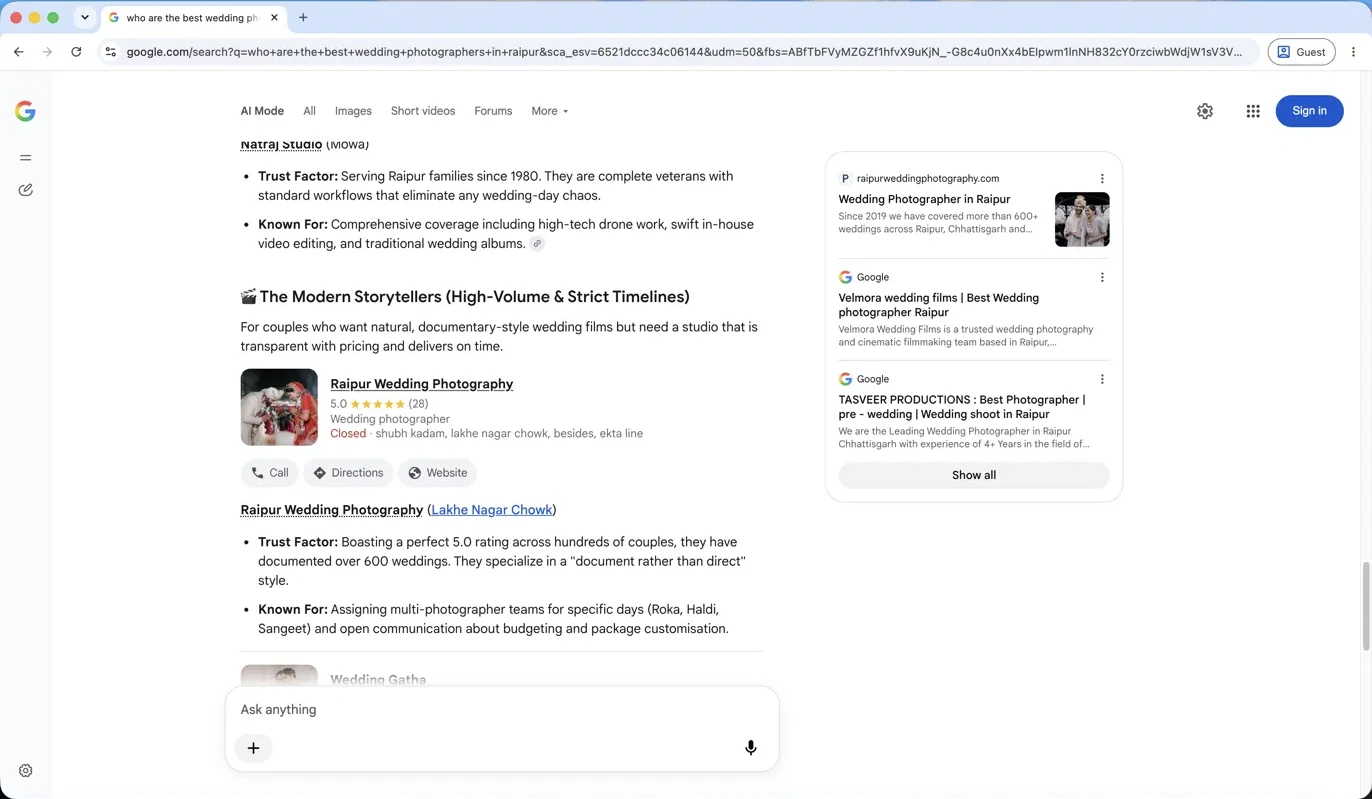
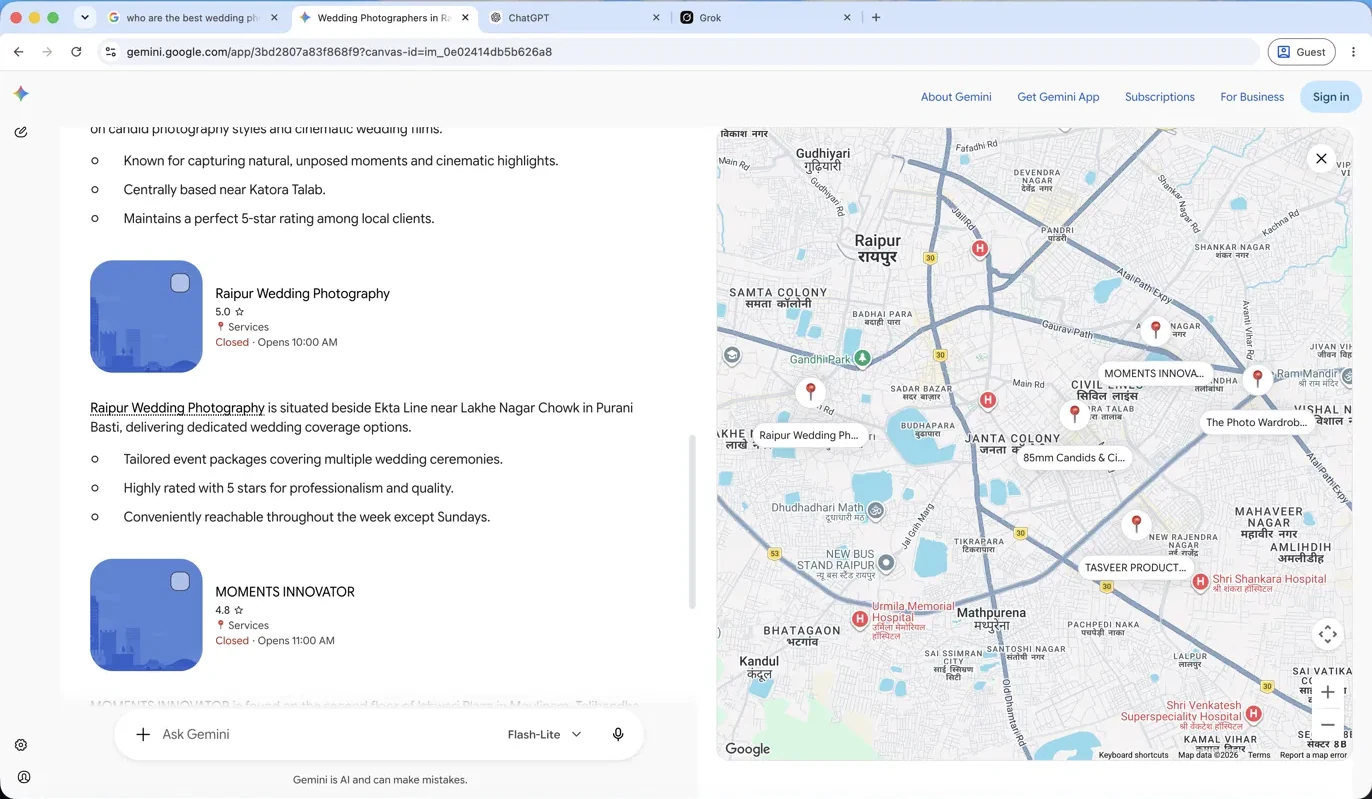
AI replies change with the person, the place and the day, so treat these as snapshots. What matters is the pattern: named again and again.
Your customers are already asking AI who to hire. Does it say your name?
Check if AI recommends meStep 1: Let the right crawlers in
If OpenAI's search crawler can't reach your pages, nothing else here matters.
OpenAI says sites that block OAI-SearchBot won't appear in its search answers, apart from the odd plain link.
The three OpenAI bots and what each one does
| Bot | What it does | My advice |
|---|---|---|
| OAI-SearchBot | Finds pages to show and cite in ChatGPT search results | Always allow it |
| GPTBot | Collects content that may train future models | Your call; blocking it won't remove you from results |
| ChatGPT-User | Opens a page when someone in a chat asks it to | Leave it allowed |
All three are usually allowed by default. Problems come from security plugins, firewalls or CDN bot settings someone forgot about.
A robots.txt file you can copy
Here's the version I start with. It lets OpenAI's search crawler and Bing in, and leaves training up to you:
User-agent: OAI-SearchBot
Allow: /

User-agent: Bingbot
Allow: /

User-agent: GPTBot
Allow: /
# Change to "Disallow: /" to opt out of training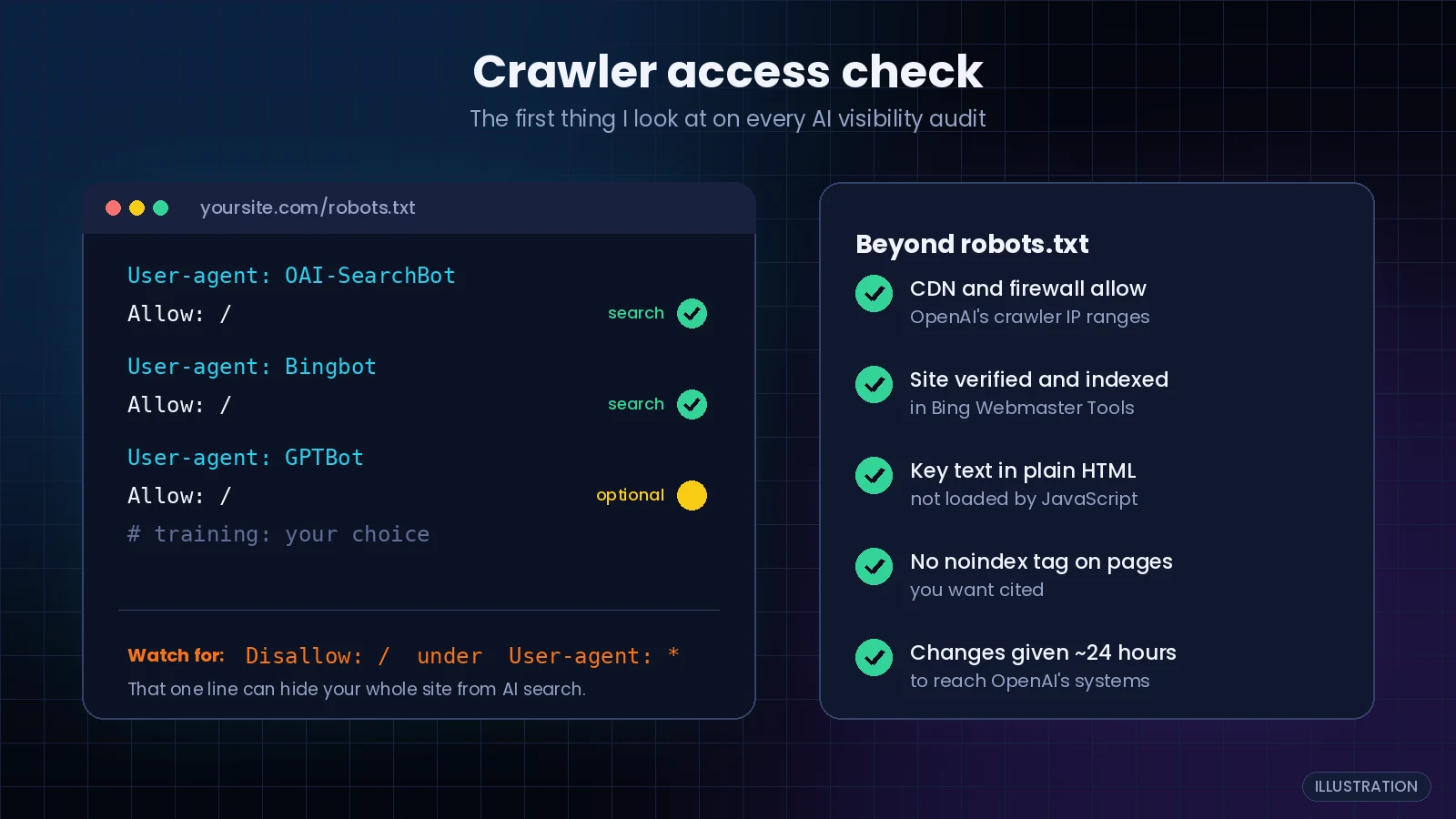
- Make sure no rule blocks OAI-SearchBot, by name or under the catch-all rule.
- Ask your host or CDN to allow OpenAI's published crawler IP ranges.
- Allow about 24 hours for robots.txt changes to reach OpenAI's systems.
- Never put noindex on a page you want cited.
Don't hide your content behind JavaScript
Unlike Googlebot, most AI crawlers don't render JavaScript. If your prices only appear after a script runs, assume the crawler never sees them.
Render important text on the server, in plain HTML.
Step 2: Get indexed in Bing
ChatGPT's early web browsing feature was literally called Browse with Bing. OpenAI doesn't name all its search providers today, but I still treat Bing as a must.
It's free, takes twenty minutes and removes one more reason to be invisible.
Verify your site in Bing Webmaster Tools
Sign in to Bing Webmaster Tools, import your site from Search Console and submit your sitemap. Then fix any pages Bing has discovered but not indexed.
This is how I ensure Bing indexing for every client before touching their content.
Use IndexNow to get new pages found faster
IndexNow tells Bing the moment you publish or update a page. Many SEO plugins and CDNs support it with one switch.
Step 3: Put the answer first
AI assistants lift text out of pages, so the easiest page to cite has the answer at the top of each section.
Look at the start of this guide: the first two lines answer the question. That's deliberate.
Turn headings into the questions people ask
Swap a vague heading like "Our Process" for the question a buyer types, such as "How long does a wedding shoot take?" Then answer it in the next sentence.
The 40-to-60-word answer block
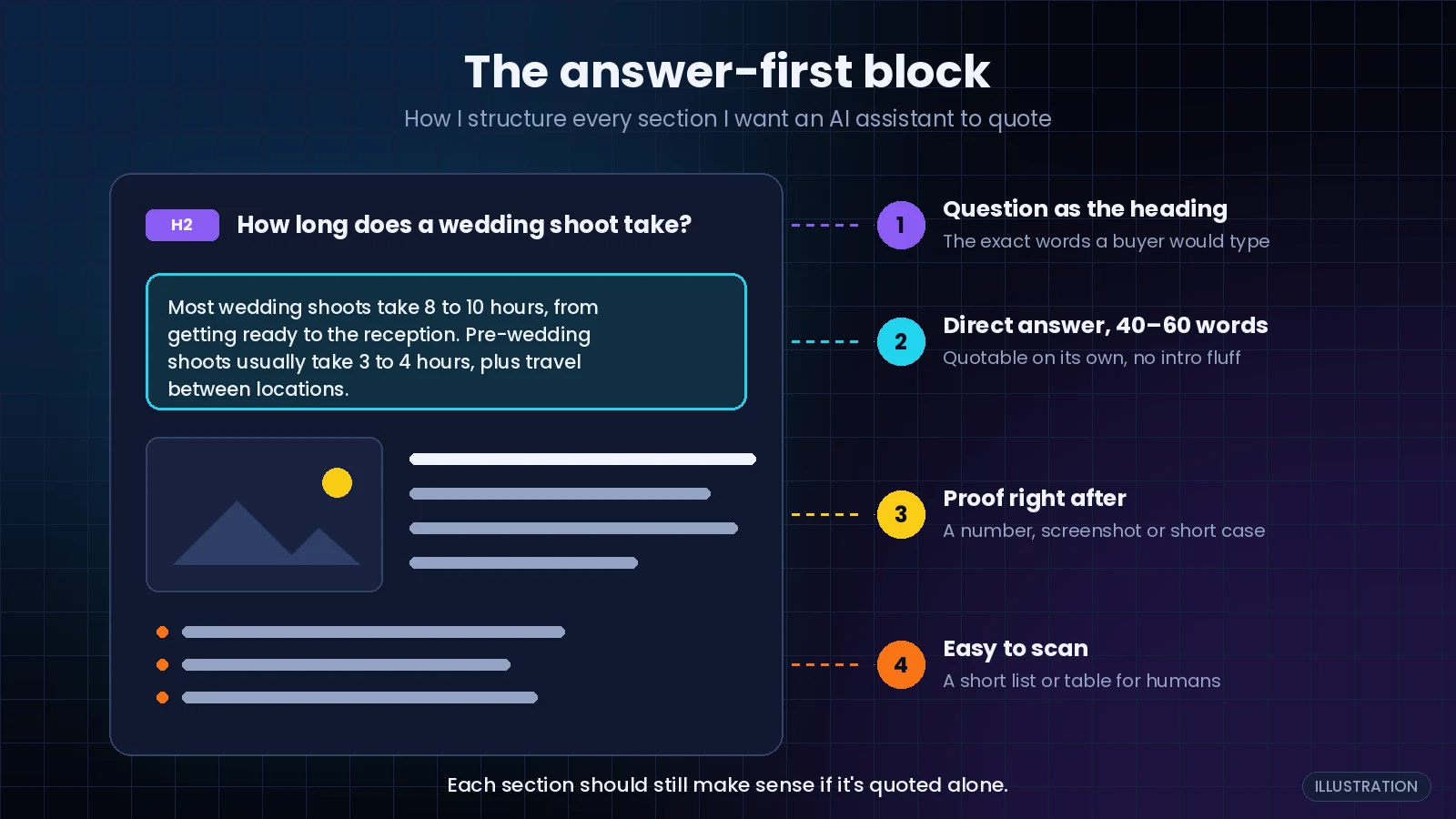
- Line one: the direct answer, in plain words.
- Line two: the reason or number behind it.
- Then: proof, like a screenshot or figure.
- Then: a list or table a human can scan.
Write each section so it still makes sense if AI quotes it alone.
Step 4: Make your business easy to understand
ChatGPT makes sense of the world through entities: people, places, companies and how they connect. The more consistent your details are, the more confidently it links your brand to a service and a location.
Say exactly who you serve and where
"We provide quality services" tells a machine nothing. "Family dentist in Bilaspur offering braces and root canals, open on Sundays" tells it almost everything.
Put a line like that on your homepage and every profile you own.
Keep your business information identical everywhere
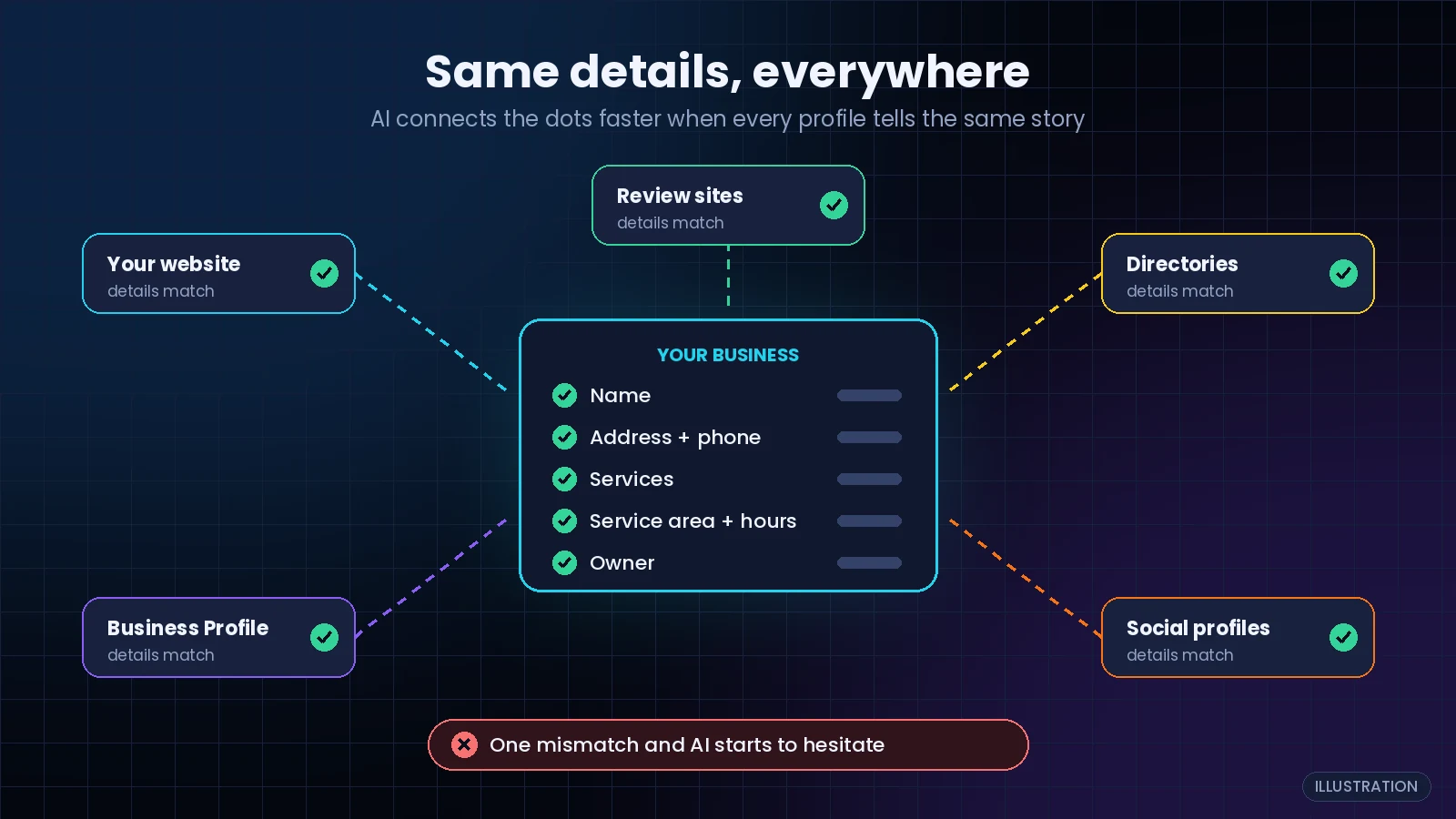
- Your brand name, spelled the same way every time
- Your address and phone, matching your Business Profile
- Your main services, described in the same words
- Your service area and opening hours
- The owner's name, linked to the business
When this information conflicts, AI hesitates, and a hesitant AI recommends someone else.
Add schema that matches the visible content
Structured data labels your information for machines. I add Organization, LocalBusiness, Person, FAQ and Article schema where it fits, and validate it first.
Schema won't force a recommendation, but it removes guesswork.
Step 5: Earn brand mentions where AI already looks
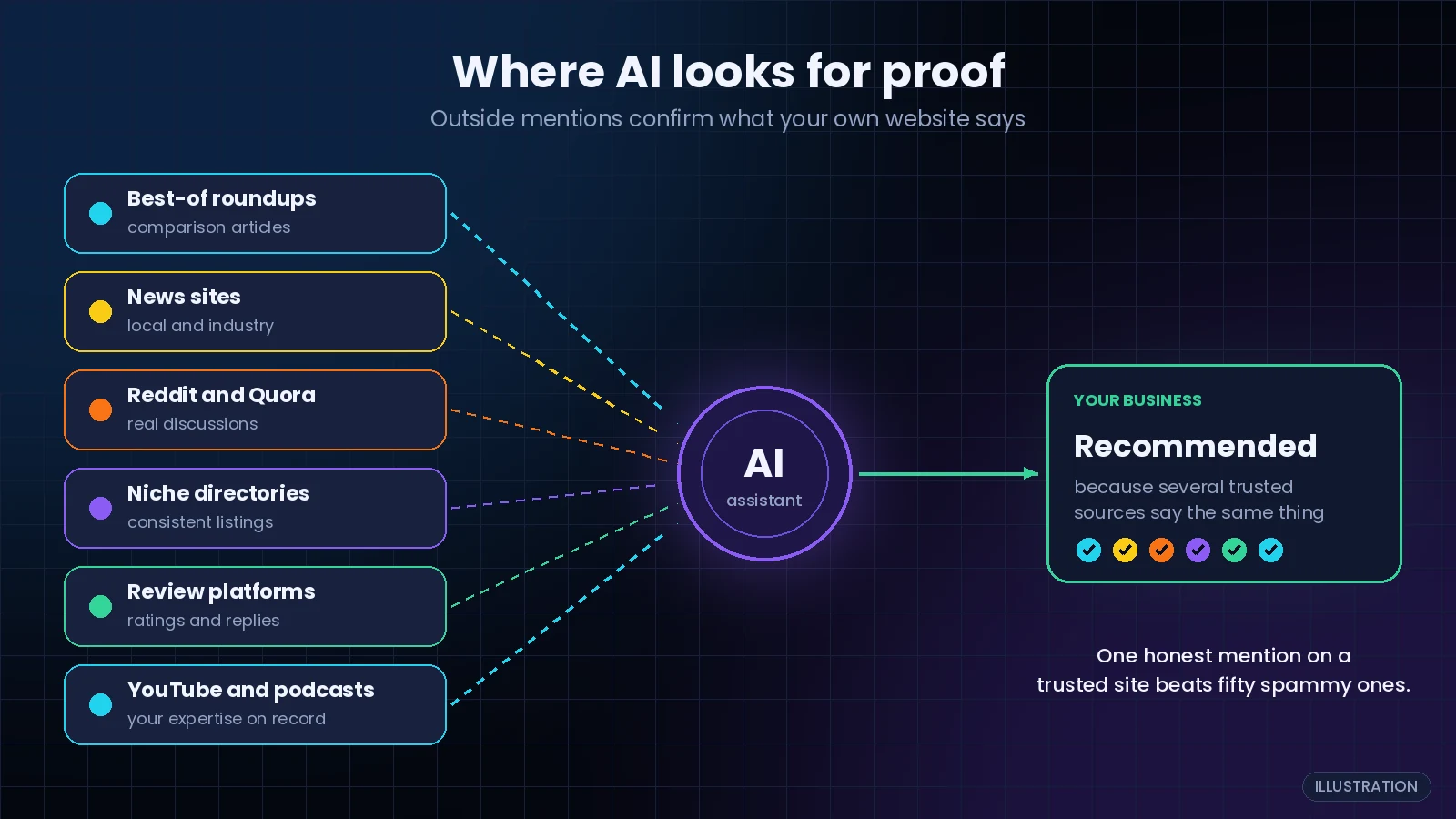
What other websites say about you often matters more than what you say about yourself. That's how authority works for AI: word-of-mouth marketing, spread across the web.
Remember my client's WeddingWire citation? That's this step in action. Here's where I look for mentions:
- "Best of" roundups and comparison articles in your niche
- Local and industry news sites
- Reddit, Quora and specialist forums
- Niche directories and review platforms
- YouTube videos and podcasts in your field
Get into the best-of lists
Ask ChatGPT your money question, like "best physiotherapist in Pune", and note which pages it cites.
Those are your targets. Pitch the writers, offer a quote or data, and ask to be included.
Show up where real people talk
Reddit, Quora and niche forums turn up in AI replies all the time. Answer questions properly, under your real name, and mention your business only when it genuinely helps.
Directories and review sites build local authority
For local businesses, the unglamorous work pays off: your Business Profile, Justdial, niche directories and review sites.
Every consistent listing adds authority your competitors might not have.
Step 6: Publish things only you can say
AI assistants love facts they can't get anywhere else. Original material gives ChatGPT a reason to quote you over the rest of the web:
- A real result with dates and screenshots
- Your own prices, timelines and process
- Small surveys or data from your customers
- Comparisons you've actually tested
Generic marketing copy is easy to ignore. Specific gets cited.
Step 7: Rank for long, specific prompts
Nobody types two words into ChatGPT. They describe their whole situation. Small businesses rarely win broad prompts, but they can win specific ones.
- "best dentist" becomes "dentist in Bilaspur for painless root canals"
- "wedding photographer" becomes "candid wedding photographer in Raipur under 1 lakh"
- "CRM software" becomes "simple CRM for a three-person real estate team"
- "accountant" becomes "accountant for a small export business in Surat"
Think of it as conversational content: one clear page for each real situation, covering who it's for, where, and at what budget.
Why local businesses have a head start
Local-intent searches are where I see small businesses win fastest. A prompt like "trusted wedding photographers in Raipur" has a limited set of possible answers.
If your details are strong, you're one of them. That's exactly how my Raipur client got in.
Step 8: Keep your information fresh
For anything that changes over time, AI assistants tend to prefer recent pages. Outdated information is easy to pass over.
I refresh my clients' key pages every three months, with new examples and a visible "last updated" date.
How to track your ChatGPT visibility
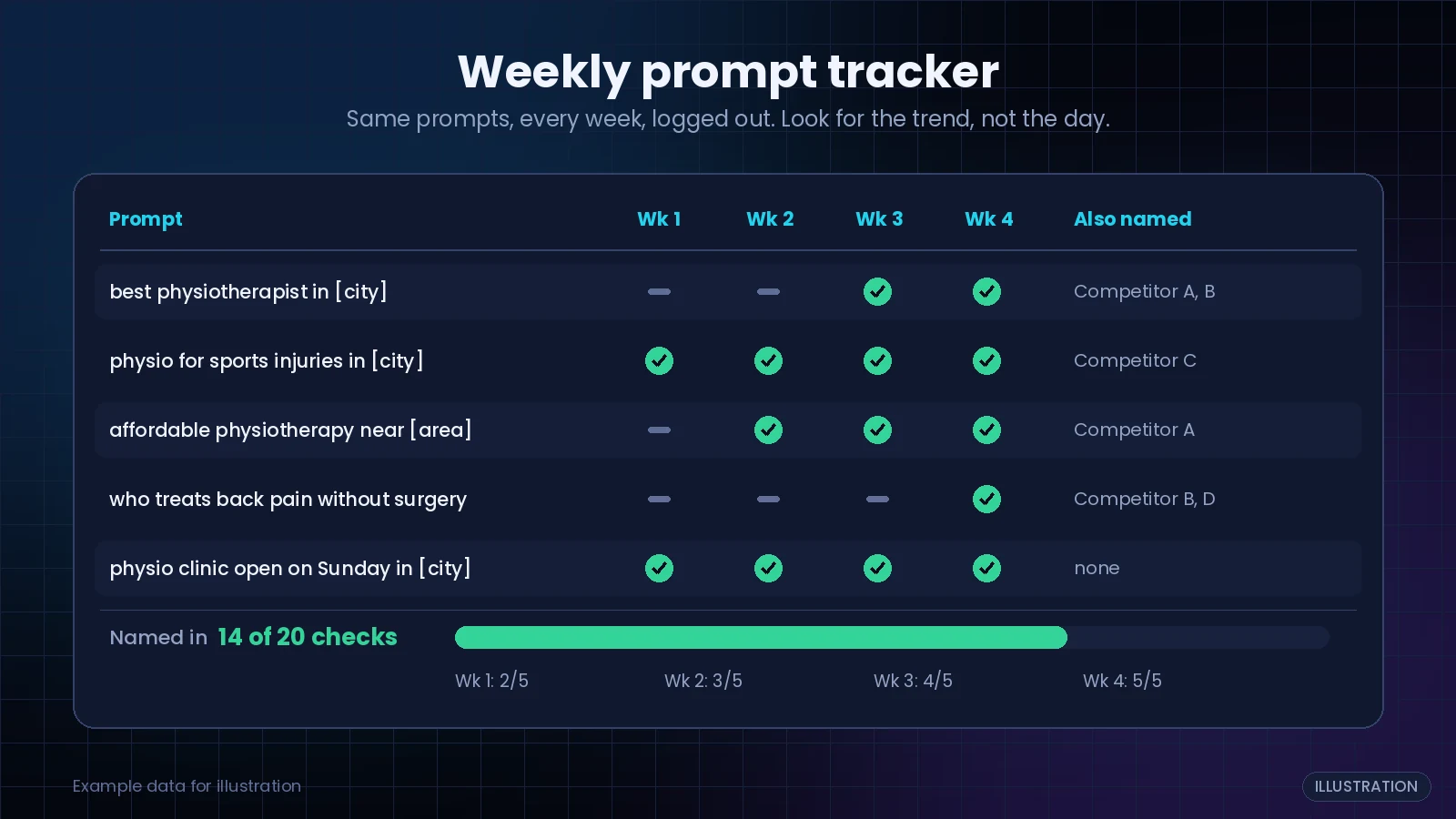
There's no Search Console for AI replies yet, so you track a fixed set of prompts on a schedule. Here's my routine:
- Write 20 to 30 real buyer prompts in your customers' own words.
- Run them every week in a fresh, logged-out chat.
- Record who's named, which competitors appear and which sources are cited.
- Look for trends over a month, not single results.
Measure AI referral traffic in Google Analytics
ChatGPT adds utm_source=chatgpt.com to the links it sends, so you can filter sessions by that source and see real traffic.
Visits and enquiries are what matter. Mentions are the early signal.
The October 2026 tracking glitch
If your ChatGPT traffic seemed to vanish between about 8 and 16 October 2026, don't panic. Analysts reported that links briefly lost that tag, so those visits landed in "Direct".
Annotate that week and compare it with the weeks either side.
Build your test prompts in 30 seconds
Fill this in and I'll draft a starter set of prompts. Paste them into ChatGPT and see who it recommends.
ChatGPT ranking factors I see in real tests
Nobody outside OpenAI knows the exact formula. But these are the signals I keep seeing in businesses that get named:
- Crawlable pages, open to OAI-SearchBot and indexed in Bing
- Direct answers at the top of each section
- Consistent details across your site and profiles
- Brand mentions on roundups, forums and review sites
- Real proof: reviews, case studies, original numbers
- Fresh content with a visible updated date
Myths that waste your time and marketing money
I hear these every week, and each one burns marketing budget.
Myth: You can pay to get recommended.
Reality: Top placement can't be guaranteed, and ads don't change the answer.
Myth: AI replaced SEO.
Reality: Without crawlable, trusted pages, AI has nothing to cite.
Myth: Repeating your keyword everywhere helps.
Reality: Stuffing a keyword makes a page worse to quote.
Myth: One screenshot proves your position.
Reality: Replies vary by person, place and day. Only weeks of tests tell the truth.
Mistakes that keep good businesses invisible
These are the problems I find most often:
- Blocking AI crawlers by accident through a plugin or CDN
- A homepage that never says plainly what you do and where
- Different names, numbers or addresses on different profiles
- No mentions anywhere except your own site
- Key details locked inside images, PDFs or scripts
How long it takes to rank
Weeks 1–2
Fix crawler access, Bing indexing and your core details.
Months 1–3
Rewrite key pages answer-first and earn mentions. You're often first named for specific prompts here.
Months 3–6
Mentions and authority compound, and broader prompts become realistic.
The honest answer: it depends on your market. A local service business can move in weeks. A national software company might need months.
When to do it yourself and when to get help
You can do all of this yourself. The technical fixes take a weekend. Content and mentions take months, and that's where most owners stall.
If you'd rather hand it over, my AI SEO services cover all eight steps, measured in calls and enquiries, not vanity screenshots.
What my AI SEO service covers
You work with me directly, not an account manager. I've completed 975+ orders on Fiverr with a 5.0 rating, and I've tested AI search for clients since 2025.
I handle crawler setup, answer-first rewrites, entity and schema fixes, mention outreach and monthly prompt tracking, alongside your digital marketing.
nikhil was very good to work with, he actually knows how to do ai seo, the report he delivered was also very insightful and covered all of the key points
Trustworthy content wins. Let's make yours the one AI quotes.
Get my free AI visibility checkGet a free ChatGPT ranking check
Send me your website on WhatsApp. Within 48 hours, I'll record a short video showing whether AI mentions you, who it recommends instead, and the first three fixes I'd make.
No sales pitch, no obligation. If you're not a good fit yet, I'll tell you.
Frequently asked questions
Can I pay to show up in ChatGPT?
No. OpenAI says top placement can't be guaranteed, and its ads don't influence replies. Being the clearest, most trusted source is the only route.
Does ChatGPT use Google or Bing?
It uses outside search providers plus OpenAI's own crawler. Its early browsing ran on Bing, so I get every client indexed on Bing and Google.
How do I do SEO ranking?
Find the questions buyers ask, answer each one clearly on a fast, crawlable page, and earn links and mentions from trusted sites.
Can I do SEO for free?
Mostly, yes. Bing Webmaster Tools, Search Console and your Business Profile are free. Paid tools just speed things up.
Is AI-powered search replacing Google?
It's adding to it. Many people ask an assistant first and still check Google afterwards, so be visible in both.
Do ChatGPT citations bring real traffic?
They can, and the utm_source tag measures it. Many people also read the reply, then search your name, so watch branded searches too, not just ChatGPT citations.
AI is already answering your customers' questions. Let's get your name into those answers.
Message me on WhatsApp and I'll send your free AI visibility check within 48 hours.
Get my free check